_edited.png)
Getting it Done
The Upper Waikirikiri Catchment (UWCC) is proving what’s possible when local farmers and community members come together with vision, commitment, and purpose. Created in the Selwyn foothills, this grassroots initiative shows that real leadership starts from the ground up - with people who know their land, care for their water, and want a sustainable future for the next generation.
A catchment group is a group of people, often farmers, who live within a catchment and would like to improve something within the area. Traditionally, this would be a watershed catchment but the evolution of the modern catchment group has seen the definition move to include land areas with commonalities such as soil types, climate, water quality and how the community lives in the space. For this reason, the Upper Waikirikiri Catchment Collective was designed to service the entire foothills area of Selwyn. The Catchment Collective is an Incorporated Society, with a steering group of twelve, elected members of the six catchment groups in the area.
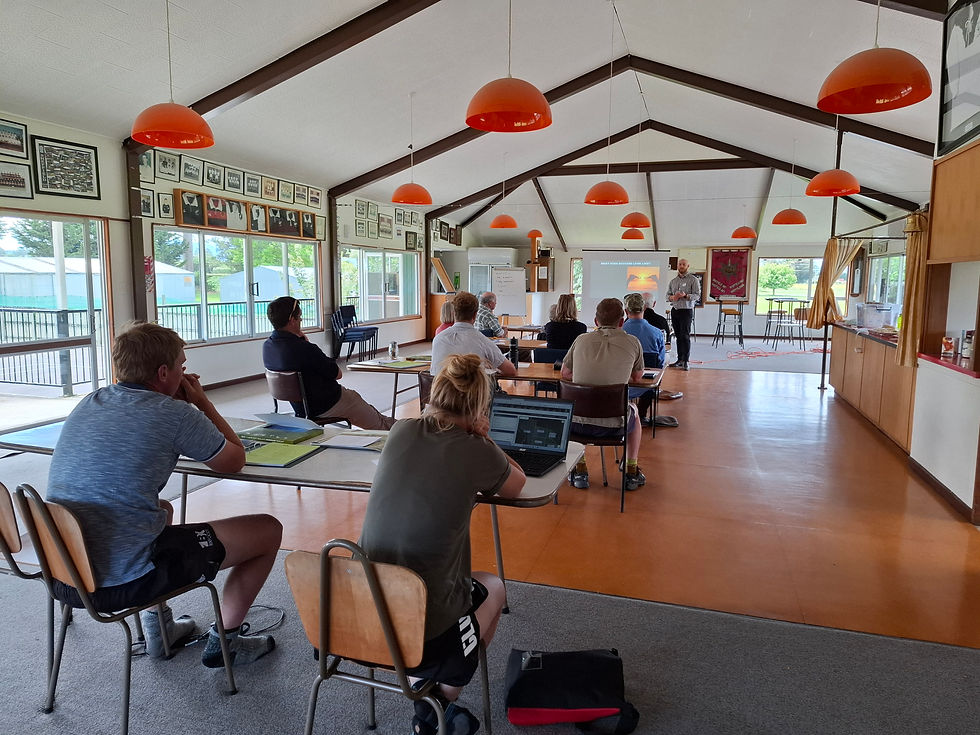
From the very beginning, UWCC has been shaped by its community. Before the group was even formed, time was invested in listening: facilitated workshops and conversations with locals both from the townships and farms helped define the vision, values, and goals that would guide the Collective. This process ensured that the group was built not just for the community, but by the community - a shared identity that people could connect with and believe in.
“Volunteering works best when people feel that they’re building something of their own,” says Tracey Perkins, the Catchment Collective facilitator and Technical Advisor. “Organisations may set KPIs for a place, but those organisations, KPIs and contact people come and go - the community remains. When people help shape the vision and values with the wisdom that lived experience, context and history brings, the identity of the group becomes theirs, and they volunteer willingly because it belongs to them.”
One of the guiding philosophies has been to respect people’s time. Members agreed early on that meetings would never be “just to meet.” Every gathering needed to add value, and every project had to deliver tangible results. That practical, results-focused approach has kept momentum high, community support strong and funders satisfied. Another guiding philosophy was to include both urban and rural spaces within the Catchment Collective’s focus, a surprisingly rare feature for a group of it’s kind.
Leadership has been a key part of the story. The Collective honours Tony Plunkett, their first chair who was instrumental in establishing the group. When Tony became unwell, Lydia Gliddon, who had the vision to start the group and was already serving as catchment coordinator, stepped into the chair role. Her determination and deep understanding of local issues have guided the Collective through its critical first years. Under Lydia’s leadership the group has been successful in gaining funding from the Ministry for Primary Industries, The Bupa Foundation, Westpac Bank, the Water Zone Committee and NZ Landcare Trust. At this year’s AGM, Lydia will step aside, opening the way for the next leader to continue this journey.
"I believe true leadership is driven by self-awareness,” Lydia says. “Knowing the value you bring, recognising how long you should serve, and having the wisdom to step aside at the right time. If you love the organisation more than you love your own position, and if you are committed to growing something bigger than yourself, then leadership means being selfless enough to hand it on when the moment is right. I’ll always be involved in serving the Catchment Collective in some capacity, because this is home, but I’m excited to see what the next period of refinement and growth can look like with someone new at the helm."
In just over a year, the Collective has already achieved a great deal. Highlights include:
Launching the “Future Focused Foothills” strategy.
Running technical workshops to make regulations more practical for farmers.
Establishing regular water-quality monitoring across the foothills.
Completing two stages of a three-stage biodiversity project.
Delivering Farm Environment Plan workshops in Sheffield, Windwhistle, and Glenroy.
Supporting the community with Rural First Aid training and planting days.
Running predator control education programmes for the community
Looking ahead, UWCC has ambitious goals:
Building local capability to tackle shared challenges.
Supporting farmers with compliance requirements while protecting the local economy.
Enhancing indigenous biodiversity by working alongside landowners.
Expanding water-quality knowledge to address significant issues.
Strengthening networks and connections across the community.
The Upper Waikirikiri Catchment Collective is free to join for anyone living in the Selwyn foothills, and the group is keen to share its experience with others starting their own catchment group journey.
“The support we’ve received from the Ministry for Primary Industries has been invaluable,” says Rick Johnson. “We hope the government continues to recognise how critical it is to back catchment groups working on the ground. The impact we’ve achieved from a relatively modest investment speaks for itself.”
UWCC is more than an organisation. It’s a community-led movement, built on local knowledge and driven by a shared commitment to people, land, and water. It proves that when leadership begins at the grassroots, extraordinary results can follow.


Published in the Selwyn Times 10 September 2025

